
You’ve been training seriously for a few years now. Your squat numbers are respectable. Your deadlift has climbed steadily. You show up consistently, you follow a program, and by most measures you’re a competent, experienced athlete.
But there’s one thing that keeps happening that you can’t explain: your lower back aches after heavy lifting days. Not a sharp, alarming pain — more of a deep, fatigued pump that settles in during the working sets and lingers into the next morning. You’ve tried more core work. You’ve tried a lifting belt. You’ve tried widening your stance, narrowing your stance, and watching every deadlift tutorial YouTube’s algorithm has ever served you.
And it keeps happening.
Here’s what nobody in those tutorials explained: the problem almost certainly isn’t your technique, your stance width, or your hamstring flexibility. It’s your breathing. Specifically, it’s the fact that your core is not generating the internal pressure it needs to protect your spine under heavy load — and until that changes, no amount of planks or ab work is going to fix the underlying issue.
At Kinetic Sports Medicine & Rehab in Centennial, CO, this is one of the most consistent findings in assessments of CrossFit athletes and weightlifters dealing with recurring lower back pain. The external movement looks fine. The internal stabilization system is failing silently — and the lower back is paying the price on every heavy set.
Understanding why that happens, and how to fix it, is the single highest-leverage thing you can do for both your performance and your long-term spinal health.
The Soda Can Your Lower Back Depends On
To understand what’s actually supposed to happen in your core during a heavy lift, picture an unopened can of soda sitting on a table. If you press down hard on the top of that can, it won’t crush. The thin aluminum walls are holding up against significant force — not because the metal itself is that strong, but because the pressurized contents inside create a rigid, uniform resistance in every direction. That internal pressure is what makes the can structurally capable of handling the load.
Now picture the same can after you’ve popped the top and let the pressure out. Press down on it with the same force and it collapses immediately. Same can. Same walls. Completely different structural outcome — because the internal pressure that made it rigid is gone.
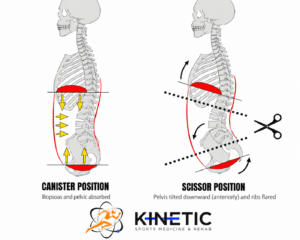
Your core works on exactly this principle. The mechanism is called Intra-Abdominal Pressure (IAP), and it is the physiological system your body uses to transform your midsection from a flexible, compressible tube into a rigid, pressurized cylinder capable of protecting your spine under heavy athletic loading.
When IAP is generated correctly, your spine is being stabilized from the inside out — not just by the surface-level muscles most people think of as “the core,” but by a 360-degree pressurization of the entire abdominal cavity. When it isn’t generated correctly, your spine relies on the superficial erector muscles and passive structures like ligaments and discs to manage forces they were never designed to handle alone. The lower back ache you feel after heavy deadlifts and squats is what that reliance feels like.
How IAP Actually Works: The Three Boundaries
True core stabilization via IAP is a coordinated effort between three structural boundaries that most athletes never consciously think about.
The roof is the diaphragm — your primary breathing muscle, which sits at the base of the ribcage and separates the chest cavity from the abdominal cavity. When it descends during inhalation, it creates downward pressure into the abdominal space.
The floor is the pelvic floor musculature. When the diaphragm descends and increases pressure downward, the pelvic floor contracts reflexively to meet it — preventing the pressure from simply escaping downward and instead redirecting it outward.
The walls are the transverse abdominis, the obliques, and the multifidus — the deep muscles that surround the abdominal cavity on all sides. When the diaphragm and pelvic floor work together correctly, the pressure they create has nowhere to go but outward against these walls, expanding the midsection in a full 360-degree radius.
It’s that outward, circumferential expansion that stiffens the lumbar spine from the inside. A 2021 systematic review in the Journal of Biomechanics confirmed what sports chiropractors and movement specialists have understood clinically for years: increased intra-abdominal pressure significantly unloads compressive forces on the lumbar spine during heavy lifting, functioning as a natural internal shock absorber.
When all three boundaries coordinate correctly — diaphragm descends, pelvic floor resists, walls expand outward — your spine is encased in a pressurized cylinder of muscular and hydraulic support. Your lower back is no longer being asked to do the stabilization job alone.
When they don’t coordinate — which is the case for the vast majority of CrossFit athletes and weightlifters who haven’t specifically trained this system — the can is open before the weight ever touches the bar.
The Old Advice That Made Your Spine Less Safe
If you’ve ever been coached on core activation, there’s a good chance you were told some version of “draw your belly button toward your spine” or “suck your stomach in before you lift.” This cue was the dominant model in physical therapy and fitness coaching for decades, and it’s based on a concept called abdominal hollowing.
Hollowing feels like it should work. Tightening inward seems like it would create stability. But biomechanically, it does the opposite of what you need.
Going back to the soda can: hollowing is like denting the walls of the can before you put weight on top of it. Instead of creating a uniform, outward-expanding pressure cylinder, you’re actively narrowing your base of support and reducing the 360-degree stiffness the spine depends on. The research led by Dr. Stuart McGill — widely considered the foremost authority on spine biomechanics — conclusively demonstrated through multiple biomechanical analyses that abdominal bracing produces significantly greater spinal stiffness and stability than hollowing. Not marginally greater. Significantly.
The modern approach, which forms the foundation of the movement assessments and rehab protocols at Kinetic Sports Medicine & Rehab in Centennial, CO, is the opposite of hollowing. Instead of drawing inward, the athlete breathes low, fills the lower abdomen and obliques, and expands outward in every direction — front, sides, and back. The cue isn’t “suck in.” It’s “push out and fill the cylinder.”
That single shift in how you think about bracing changes the mechanical environment your spine operates in on every heavy rep.
Why This Matters Beyond Just Back Pain
Lower back ache after lifting is the most visible consequence of poor IAP — but it’s not the only one. For Denver Metro CrossFit athletes and weightlifters who train at high intensity and volume, a failing IAP system creates a cascade of downstream effects that limits both performance and long-term structural health.
Force transfer and athletic output. You cannot fire a cannon from a canoe. Every sport and every strength movement depends on the ability to transfer force from the lower body through a stable midsection into the upper body. A golf swing, a clean and jerk, a sprint — all of them require the core to act as a rigid conduit, not a compressible link. Without adequate IAP, energy leaks out of the midsection on every rep and every stride. Athletes experience this as feeling “disconnected” between their lower and upper body, or noticing that their legs feel strong but their lifts stall out at a certain weight regardless of how much they train the movement itself.
Nervous system recovery. This is the piece most athletes don’t expect. Chronic “chest breathing” — using the neck and upper shoulder muscles to drive respiration instead of the diaphragm — keeps the sympathetic nervous system in a mild but persistent state of activation. It’s a subtle fight-or-flight signal that impairs sleep quality, slows recovery between sessions, and contributes to the accumulated fatigue that athletes often attribute to overtraining. Proper diaphragmatic breathing stimulates the vagus nerve, shifting the autonomic nervous system toward the parasympathetic state that genuine recovery requires. Teaching an athlete to breathe correctly isn’t just a stability intervention — it’s a recovery intervention.
Structural injury risk. When the IAP system fails chronically, specific structures absorb the consequences. The lumbar discs are exposed to compressive and shear forces without the buffering effect of internal pressure. The facet joints hyperextend to compensate for a lack of anterior core stiffness. The sports hernia risk increases as pressure is directed downward rather than distributing uniformly. And the upper trapezius and cervical musculature chronically overactivate as accessory breathing muscles, producing the neck tightness and upper back tension that many athletes assume is simply the result of heavy training.
At Kinetic Sports Medicine & Rehab, a sports chiropractor’s assessment of a weightlifter or CrossFit athlete with recurring lower back pain will almost always include a breathing mechanics evaluation — because the breathing pattern is frequently the upstream root of the structural complaints that brought the athlete in.
The Common Questions This Answers
“Why does my lower back pump up and ache during deadlifts?”
Because the erector muscles are substituting for the IAP that the diaphragm, pelvic floor, and deep core should be generating. Without internal pressure stabilizing the spine from the inside, the superficial back extensors have to work at maximum output throughout the entire set. They fatigue, they pump, and they ache — because they’re doing two jobs instead of one.
“Should I suck my stomach in when I brace?”
No. Hollowing narrows the pressure cylinder and reduces the circumferential stiffness that protects the spine. The correct cue is to breathe low, fill the obliques and lower back, and expand outward in every direction before the load is applied.
“Does a lifting belt weaken my core?”
This is one of the most persistent myths in strength training, and the biomechanics answer it clearly: no. A lifting belt provides a rigid external boundary for your muscles to push against, which actually enhances the IAP response by giving the expanding core musculature something to work against. The key is wearing the belt correctly — one notch looser than maximum — and actively trying to expand your core to push against it on all sides, not just the front. Athletes who report that belts have “weakened” their core are typically using the belt as a substitute for bracing rather than an amplifier of it.
Three Drills to Start Training IAP Right Now
Understanding the concept is the starting point. Training the neuromuscular pattern that makes it automatic under load is the actual work. Here are three progressively applied drills used in assessments and rehab protocols at Kinetic Sports Medicine & Rehab in Centennial, Colorado:
Crocodile Breathing — Building Awareness
Lie face down on the floor with your hands stacked under your forehead. This position is the most effective starting point for IAP training because the floor blocks the stomach from expanding forward, forcing the breath to find the only paths available: the obliques and the lower back. Breathe slowly and try to feel your lower back rise on the inhale and fall on the exhale. Most athletes have never felt their lower back move with breath — if yours doesn’t, you’ve just identified the pattern that’s been failing you under the bar.
Practice five to ten minutes of crocodile breathing daily until the lower back expansion feels natural and accessible without conscious effort.
The 90/90 Supine — Coordinating the Cylinder
Lie on your back with your feet flat on a wall, knees and hips both bent to approximately 90 degrees. Exhale fully, feeling the ribcage drop down and the lower back press gently into the floor. From that position, inhale slowly into the lower abdomen and obliques — specifically trying to keep the chest from rising and the ribcage from flaring. Press your hands lightly into your thighs to create a gentle co-contraction, and hold the 360-degree pressure for five to eight seconds before exhaling and repeating.
This drill directly trains the coordination between the diaphragm, pelvic floor, and transverse abdominis that produces genuine IAP. It is the foundation of DNS — Dynamic Neuromuscular Stabilization — which forms a central component of the movement reprogramming approach at Kinetic Sports Medicine & Rehab.
The Belt Cue — Applying IAP Under Load
Once the awareness and activation drills feel accessible, the belt cue bridges the gap to actual lifting application. Put on a weightlifting belt one notch looser than you normally would. Before initiating any lift, take a deliberate low breath and try to expand your core to tighten the belt from every direction simultaneously — front, sides, and particularly the back. The goal is to feel the belt tighten at the sides and lower back, not just the front. Hold that pressure through the entire rep, exhaling only at the top of a completed lift.
This cue gives athletes a real-time proprioceptive feedback loop for whether IAP is being generated correctly — something that abstract bracing cues alone cannot provide.
What a Sports Medicine Assessment Adds
These three drills will meaningfully improve IAP awareness and activation for most athletes who practice them consistently. But for Denver Metro weightlifters and CrossFit athletes dealing with chronic lower back pain, recurring performance limitations, or movement patterns that haven’t changed despite consistent training, the drills alone are addressing the symptom rather than the full picture.
At Kinetic Sports Medicine & Rehab in Centennial, Colorado, a comprehensive sports chiropractic assessment evaluates the entire system that IAP depends on. Breathing pattern, diaphragm mobility, thoracic spine restriction, pelvic floor coordination, and deep core activation are all assessed as an integrated functional unit — not as isolated structures. When the thoracic spine is restricted, the diaphragm can’t descend fully. When the pelvic floor isn’t coordinating with the breath, IAP dissipates rather than builds. When the ribcage is habitually elevated, the entire pressure cylinder is mechanically compromised before the first rep begins.
DNS principles are used to retrain the foundational coordination pattern from the ground up — not by adding more core exercises to a program, but by resetting the neuromuscular sequencing that determines whether the core functions as a pressurized cylinder or an open can under load.
Dry needling addresses the chronic upper trapezius, cervical, and thoracic restrictions that develop in athletes who have been chest-breathing for years — releasing the accessory breathing pattern that has been substituting for diaphragmatic function and restoring the thoracic mobility that proper IAP mechanics depend on.
And the return-to-performance protocol is built specifically around the athlete’s training program, competition schedule, and movement demands — so IAP isn’t just trained in isolation on the clinic floor, but integrated directly into the lifting patterns that have been causing problems.
The Bottom Line for Denver Metro Athletes
The lower back ache you feel after heavy lifting days is not a mystery. It’s a predictable mechanical consequence of a core stabilization system that is generating internal pressure inconsistently or insufficiently — leaving your spine to manage heavy load without the pressurized cylinder that was designed to protect it.
The good news is that this is a trainable system. Unlike structural damage, a breathing mechanics and IAP deficit responds quickly and measurably to the right intervention. Most athletes who begin deliberately training IAP notice a meaningful change in how their lower back responds to heavy lifting within two to three weeks — not because they got stronger in the conventional sense, but because they stopped asking their erector muscles to do a job that the entire core cylinder was supposed to be doing together.
If you’ve been managing recurring lower back discomfort after lifting and want to understand exactly what’s failing in your stabilization system — and how to fix it before it becomes a structural injury — a movement assessment at Kinetic Sports Medicine & Rehab in Centennial, CO is the most direct path to that answer.
The can doesn’t have to be open. Let’s pressurize it.
Dealing with lower back pain after heavy lifting? The sports chiropractic team at Kinetic Sports Medicine & Rehab in Centennial, CO specializes in identifying the breathing mechanics and core stabilization deficits that keep Denver Metro CrossFit athletes and weightlifters stuck — and building a targeted plan to fix them before they become serious injuries.