
You bought the compression strap. You iced it after every round. You took two weeks off, let it settle down, and told yourself that this time you’d come back more carefully. You did. You played nine holes instead of eighteen. You swung easier. You even stretched your forearm every morning like the internet told you to.
And somewhere around the fourth hole at Arrowhead, on a perfectly unremarkable approach shot, it was back. Same spot. Same ache radiating from the inside of your elbow down into your forearm. Same quiet frustration that you’re exactly where you started — except now you’re two weeks behind on your game and no closer to understanding what’s actually wrong.
If this sounds familiar, here’s the most important thing anyone has told you about your golfer’s elbow: the elbow is not the problem.
It’s the victim. And until someone starts treating the actual criminal, you’ll keep cycling through the same compression strap, the same two weeks off, the same optimistic return, and the same fourth-hole reminder that nothing has changed.
The Elbow Is a Dumb Hinge
That’s not an insult — it’s an anatomical reality that changes everything about how golfer’s elbow should be approached.
The elbow is a hinge joint. It bends and straightens. That’s its primary mechanical function. It doesn’t generate power. It doesn’t initiate rotation. It doesn’t drive clubhead speed. In a well-functioning golf swing, the elbow is essentially a passive conduit — a link in a chain that transfers energy generated far upstream, in the hips and thoracic spine, down through the shoulder and arm and into the club.
The medial epicondyle — the bony prominence on the inside of your elbow where golfer’s elbow lives — is the attachment point for the forearm flexor tendons. These tendons become irritated and develop the micro-tearing characteristic of tendinopathy when they’re repeatedly asked to absorb forces beyond their capacity. But here’s the key question that most treatment approaches never ask: why are those tendons absorbing forces beyond their capacity in the first place?
The answer almost never begins at the elbow.
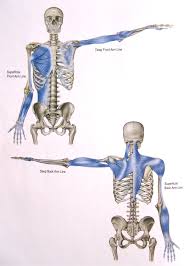
In sports medicine, the framework that explains what’s actually happening is called Regional Interdependence — the principle that dysfunction in one region of the body predictably creates compensatory overload in adjacent regions. The elbow sits between two highly mobile joints: the shoulder above it and the wrist below it. When the shoulder lacks stability or the wrist lacks mobility, the elbow is forced to absorb the mechanical stress those joints aren’t managing. It becomes the path of least resistance for forces the rest of the chain isn’t handling correctly.
Treating the elbow without evaluating the shoulder, the thoracic spine, and the hips is treating the symptom while ignoring every single cause. It’s why the compression strap provides temporary relief and nothing more. The strap addresses the site of pain. It does nothing about why the site of pain keeps being overloaded.
Where the Real Problem Actually Lives
To understand what’s driving your golfer’s elbow, you need to understand where golf swing power is supposed to come from — and what happens when it doesn’t come from there.
A mechanically sound golf swing generates power from the ground up. The lower body initiates, the hips rotate, the thoracic spine coils against that hip rotation to create elastic tension, and that stored energy releases through a stable shoulder, down the arm, and into the club. The forearm muscles in this model are doing a relatively modest job: maintaining grip and controlling the clubface through impact.
Now consider what happens when two of the most common mobility restrictions in Denver Metro recreational golfers are present simultaneously: thoracic spine stiffness from sitting at a desk forty hours a week, and restricted lead hip internal rotation from the same.
The body still needs to generate clubhead speed. That demand doesn’t disappear because the primary power generators aren’t available. So it compensates. Without adequate thoracic rotation and hip mobility to coil and release correctly, the swing becomes arm-dominated — the forearm muscles have to violently pull the club through the impact zone to manufacture the speed that the hips and back should have provided. The tiny medial epicondyle tendon, designed to manage a fraction of that force, is now absorbing the mechanical output of the entire swing.
Do that over seventy to ninety swings in a round, three or four rounds per week, across an entire golf season — and you have a very efficient machine for producing a tendon that never gets the chance to heal.
Research on golf biomechanics has quantified exactly what this costs the elbow. A breakdown in the kinetic chain — specifically decreased hip rotation and reduced core stability — increases the eccentric load on the medial elbow by up to 30%. That is not a marginal increase. That is the difference between a tendon that can manage the stress of a full swing and one that is being progressively overloaded every time you play.
The Three Hidden Culprits in Chronic Golfer’s Elbow
For Denver Metro golfers dealing with recurring medial elbow pain, three upstream contributors are responsible for the vast majority of cases that don’t respond to standard local treatment.
Thoracic spine stiffness. The mid-back is supposed to provide the rotational range that powers the swing. When it’s restricted — and after years of desk work, driving, and recreational golf without targeted mobility work, thoracic stiffness is nearly universal in the 40–60 age range — the swing loses its primary rotational engine. The body compensates by over-rotating the lumbar spine below (which loads the lower back) and over-relying on the arms above (which loads the elbow). Mobilizing the thoracic spine doesn’t just help the back — it directly reduces the demand placed on the medial elbow by restoring the swing’s proper power source.
Lead hip internal rotation restriction. During the downswing, the lead hip needs to internally rotate to “clear” — to create the space for the pelvis to rotate through impact. When that hip mobility isn’t available, golfers compensate with what’s called early extension: the hips thrust toward the ball and the upper body has to compensate to maintain the swing path. This compensation pattern consistently increases arm dominance through impact, putting the forearm flexors under maximal eccentric load at exactly the moment the club strikes the ball or turf. If your lead hip can’t clear, your elbow pays for it on every swing.
Scapular instability. The shoulder blade is the platform the entire arm operates from. The lower trapezius and serratus anterior — two muscles that rarely get attention in standard golf fitness programs — are responsible for anchoring the shoulder blade against the ribcage and controlling its movement through the swing. Research published in the Journal of Orthopaedic & Sports Physical Therapy found that athletes with chronic medial elbow pain consistently demonstrate significant weakness in precisely these muscles compared to healthy controls. When the shoulder blade isn’t properly anchored, the arm loses its stable base and the forearm muscles have to work overtime to stabilize a system that should be controlled much further up the chain.
The Swing Mechanics Making It Worse
Beyond physical limitations, two common swing patterns directly amplify the load on the medial elbow — and if your equipment isn’t matched to your game, it may be accelerating the problem.
Casting from the top. When you lose your wrist angle — your “lag” — too early in the downswing, the forearm flexors have to contract maximally to try to recover speed at the worst possible moment. This is one of the most mechanically destructive patterns for the medial elbow in recreational golfers, and it’s often a compensation for the thoracic and hip restrictions described above. When you can’t generate speed from rotation, the brain instinctively tries to find it from the arms — and casting is what that looks like.
The “fat shot” shockwave. Consistently hitting the turf before the ball sends a violent shockwave directly up the shaft and into the medial flexor tendon. If you’re hitting fat shots regularly, your elbow is absorbing an impact force it was never designed to handle. This is often related to early extension and poor contact mechanics — both of which come back to the kinetic chain failures described above.
The death grip. Gripping the club too tightly — which many golfers do unconsciously, particularly when swing anxiety is present or when grips have worn thin and are too small — keeps the forearm flexors in a state of near-constant tension throughout the swing. A muscle that never fully relaxes never fully recovers. Checking your grip pressure and grip size is one of the simplest equipment changes you can make, and for some golfers it produces an immediate reduction in symptoms.
What a Proper Assessment Actually Looks Like
A comprehensive assessment for golfer’s elbow at Kinetic Sports Medicine & Rehab using the Titlist Performance Institute (TPI) chiropractic and physical therapy golf screen, amonng other functional movements tests, begins well away from the elbow itself. Before any treatment is applied to the medial epicondyle, the following need to be evaluated:
Thoracic rotation screening. Can you rotate your mid-back 45 degrees or more in both directions without your hips moving? If not, your swing is operating without its primary rotational engine and your arm is compensating for every degree of missing thoracic range.
Lead hip internal rotation. Does your lead hip have the mobility to clear during the downswing, or are you using early extension to manufacture the space the hip should be creating? Hip internal rotation restriction is one of the most consistent findings in golfers with chronic elbow pain — and one of the most consistently undertreated.
Scapular stability assessment. Are your lower trapezius and serratus anterior firing correctly to anchor the shoulder blade during the swing? A simple movement screen will reveal whether the shoulder blade is moving in a controlled, stable pattern or drifting and winging in a way that transfers load to the elbow.
Cervical nerve tension testing. This is a critical step that purely local elbow treatments skip entirely. Irritation of the C8 or T1 nerve roots in the neck can produce medial elbow pain that is clinically indistinguishable from golfer’s elbow tendinopathy. Treating a nerve referral pattern with forearm eccentric loading and compression straps is not just ineffective — it’s the wrong intervention for the wrong structure. Ruling out cervical nerve involvement before assuming the problem is purely local is a non-negotiable part of a thorough assessment.
What Treatment Actually Looks Like When It Addresses the Full Chain
Once the assessment identifies the specific contributors driving your elbow pain, treatment targets each level of the kinetic chain rather than just the symptom site.
Eccentric loading for the tendon. The medial flexor tendon does need direct rehabilitation — but it should be one component of a comprehensive plan, not the entire plan. Heavy, slow eccentric wrist curls apply the progressive mechanical stimulus that drives collagen remodeling and rebuilds the tendon’s structural capacity. This is supported by decades of tendinopathy research as the gold standard for rebuilding disorganized tendon tissue. The key is that it’s paired with upstream treatment, not used in isolation.
Thoracic and hip mobility restoration. Joint mobilizations targeting the thoracic spine restore the rotational range the swing needs from its primary power source. Hip mobility work — specifically targeting lead hip internal rotation — restores the hip clearing mechanics that allow the pelvis to rotate through impact without forcing the arms to compensate. When these two components are addressed, the mechanical demand on the elbow drops significantly — often producing a noticeable reduction in symptoms within a few sessions even before the tendon has fully remodeled.
Dry needling, ART, and Graston for the forearm complex. The forearm flexor muscles in a golfer dealing with chronic medial elbow pain are almost always carrying deep trigger points and fascial restrictions that no amount of forearm stretching reaches. Dry needling directly releases these trigger points, restoring normal tissue extensibility and reducing the baseline tension the tendon is operating under. Active Release Technique and Graston work clear the fascial adhesions in the shoulder and neck that limit the arm’s mechanical freedom through the swing.
Shockwave therapy for stubborn tendons. The medial epicondyle tendons are relatively poorly vascularized — they receive limited blood supply under normal conditions, which slows their biological healing. For golfers dealing with chronic, long-standing golfer’s elbow that has stalled despite good rehabilitation effort, shockwave therapy uses acoustic energy to stimulate blood flow and trigger the collagen remodeling process in tissue that has been sitting in a stalled healing state. This is particularly valuable for cases that have been managed for three months or more without full resolution.
DNS for the core foundation. At Kinetic Sports Medicine & Rehab, Dynamic Neuromuscular Stabilization principles are used to ensure the core is generating adequate intra-abdominal pressure — the internal stability system that gives the shoulder blade a solid platform and allows force to transfer through the chain without the arm having to compensate. Many golfers breathe exclusively into their chest, which collapses the intra-abdominal pressure that the deep core should be maintaining throughout the swing. When that pressure system is restored, the mechanical environment the elbow operates in changes fundamentally — not because the elbow was directly treated, but because the system it depends on is finally functioning correctly.
Realistic Expectations for Denver Metro Golfers
Golfer’s elbow that has been present and recurring for multiple months is not a two-week fix — but it is entirely fixable when the right contributors are identified and addressed. Here’s what a realistic recovery timeline looks like when the full kinetic chain is being treated:
In the first two to three weeks, the combination of dry needling, joint mobilization, and upstream mobility work typically produces a meaningful reduction in baseline pain — not because the tendon has remodeled yet, but because the mechanical overload that has been perpetuating the irritation is being reduced. Many golfers notice an improvement in their swing mechanics alongside the pain reduction, because the thoracic and hip restrictions that were driving the compensation pattern are being addressed at the same time.
Over the following four to eight weeks, the progressive tendon loading protocol rebuilds the structural capacity of the medial flexor tendon. The 24-hour pain response rule governs progression: if symptoms remain at or below baseline the morning after a round, the tissue is handling the load. If they’re elevated, the volume or intensity of play needs to be temporarily reduced before advancing.
Full return to unrestricted play — including range sessions, full rounds, and competitive golf — is the functional benchmark. Not zero tenderness on palpation. Not a structurally perfect tendon on ultrasound. The ability to play a complete round and wake up the next morning without elbow soreness that wasn’t there before. That is the standard, and for the vast majority of golfers who commit to a comprehensive kinetic chain approach, it is achievable.
The Bottom Line
Your golfer’s elbow keeps coming back because every treatment you’ve tried has addressed the site of pain without touching the source of it. The compression strap quiets the elbow. The ibuprofen reduces the inflammation. The rest lets the tendon settle. And then you swing a club, the thoracic spine doesn’t rotate, the lead hip doesn’t clear, the arm has to do the work the hips and back should be doing — and the tendon that never had any of those demands changed is right back where it started.
The elbow is not the problem. It is the most visible consequence of a kinetic chain that is breaking down somewhere upstream. Fix the chain — restore the thoracic rotation, free the lead hip, anchor the shoulder blade, and rebuild the tendon’s capacity to handle proper swing loads — and the elbow stops being the sacrificial lamb it’s been for the past several months.
CommonGround is waiting. Arrowhead is waiting. Your game is waiting. Let’s figure out what’s actually driving this and build a plan that gets you back to playing full rounds without managing your swing around an elbow that shouldn’t be hurting in the first place.
Dealing with golfer’s elbow that keeps coming back no matter what you try?
The sports medicine team at Kinetic Sports Medicine & Rehab serves golfers across the Denver Metro area with comprehensive kinetic chain assessments that identify what’s actually driving your elbow pain — and build a treatment plan that addresses every level of it.
Schedule your assessment today and stop treating the symptom.