
You knew something was off the moment it happened. Maybe it was rep twelve of a heavy deadlift set. Maybe it was the kipping pull-ups at the end of a long WOD. Maybe it was a kettlebell swing that felt fine for the first twenty reps and then very much didn’t. Whatever the movement, you felt that familiar grab in your lower back — that sharp catch or deep ache that tells you today’s session is over, whether you want it to be or not.
Now you’re at home, moving carefully, dreading tomorrow morning’s stiffness, and asking the question that every CrossFit athlete in Centennial asks themselves in this moment: do I have to stop training completely?
The short answer is almost certainly no. The longer answer is that how you handle the next two to three weeks will determine whether this becomes a minor setback you recover from quickly or a recurring injury that dogs you for the rest of the season. The difference between those two outcomes isn’t how much you rest — it’s how intelligently yo u keep moving.
What Actually Happened to Your Back
Before getting into what to do, it helps to understand what you’re actually dealing with.
A lumbar strain means the muscles or ligaments of the lower back have been overstretched or micro-torn — usually because the load demand of a movement exceeded the capacity of the core to stabilize the spine in that moment. This is not a disc herniation. It is not a fracture. It is not a sign that your lifting days are over. It is a soft tissue injury, and like all soft tissue injuries, it heals best with controlled movement and progressive loading — not with bed rest and avoidance.
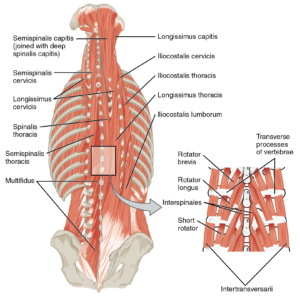
lumbar spine strain, low back pain muscles
The clinical guidelines for acute low back pain have shifted dramatically over the last decade. Guidelines published in major medical journals, including The Lancet, now strongly advise against bed rest for non-specific low back pain. Active management — staying physically active within pain limits — consistently leads to faster recovery, less chronic pain, and lower recurrence rates than rest-based approaches. The research is clear enough at this point that recommending complete rest for a lumbar strain is considered an outdated clinical position.
What this means for you practically: stopping CrossFit entirely is not just unnecessary — it’s likely counterproductive. The goal is not to stop training. The goal is to train the right things, avoid the wrong things, and monitor your tissue’s response carefully so you can progress back to full intensity without resetting the clock.
Here’s how to do that.
The Movements That Need to Come Out (And Why)
A lumbar strain means specific biomechanical stressors need to be temporarily removed from your training — not because movement is dangerous, but because certain movements create the exact mechanical environment that prevents the strained tissue from consolidating.
High-velocity flexion and extension — burpees, kipping pull-ups, toes-to-bar, and high-rep kettlebell swings — rapidly snap the spine between a rounded and arched position under load or momentum. The strained tissue cannot tolerate that repeated end-range stress while it’s actively trying to remodel. These come out of your programming until you’re significantly further along in recovery.
Heavy axial loading — barbell back squats and heavy overhead presses — places compressive load directly down through the spinal column. In a healthy, well-stabilized spine this is manageable. In a spine where the supporting musculature is currently guarded and inflamed, it’s asking a compromised system to handle full competition loads. The weight comes down significantly, and the movement patterns get modified.
Shear forces under load — heavy deadlifts, bent-over barbell rows, and good mornings — are hinging movements where the core has to work maximally to lock the pelvis and spine together against a large external force. If that core lock fails even briefly — which it’s more likely to do when the lower back is already guarded — the shear force transfers directly to the strained tissue. These are the movements most likely to reset your recovery timeline if you return to them too aggressively.
Spinal flexion under load — GHD sit-ups, traditional sit-ups, Russian twists — ask the already-irritated tissue to lengthen and shorten under tension. This is not the time for those movements. The core’s actual job is to resist movement, not create it, and that’s exactly what your rehabilitation exercises should reflect.
What to Do Instead: The Smart Substitutions
Here’s the part that should genuinely reassure you: you can hit every major energy system and muscle group your regular CrossFit programming targets without doing a single one of the movements above. The substitutions are not easier in any meaningful sense — they just don’t load the strained tissue in the ways that will set you back.
Instead of back squats, use goblet squats or Bulgarian split squats with a dumbbell held at chest height. The anterior load position automatically engages the front of your core and prevents the lower back from hyperextending under load. Unilateral work like split squats challenges the legs intensely at roughly half the spinal compression of a barbell squat — and the single-leg demand adds a stability challenge that makes it genuinely hard work even at reduced loads.
Instead of deadlifts, heavy sled pushes and glute bridges become your primary hip hinge and posterior chain tools. The sled allows you to generate significant force through the legs and hips with essentially zero shear force on the lower back — no eccentric component, no spinal flexion, just pure hip drive. Glute bridges load the glutes and hamstrings in a position that actually decompresses the lower back rather than loading it.
Instead of burpees, box up-downs on a 20-inch box eliminate the deep spinal flexion of getting all the way to the floor. Step back into a plank, step up, stand. The metabolic demand is similar; the spinal position stays safe. Assault bike sprints are an even better option — maximum heart rate zones with zero spinal impact.
Instead of sit-ups and GHD work, dead bugs and Pallof presses become your core training. These are anti-movement exercises — they train your core to resist rotation, resist extension, and maintain a stable neutral spine under load. That is literally the core’s primary function, and research consistently shows that isometric and anti-movement core exercises are significantly more effective at reducing lower back pain than flexion-based exercises like crunches and sit-ups.
How to Adjust Your Training Volume and Intensity
Swapping movements is only half of the equation. The other half is modifying how you train the substituted movements so you’re building fitness without overloading the healing tissue.
Cut the load by 40 to 50% and slow the tempo down. Drop your working weights significantly and use a three-second lowering phase on every rep. A slow eccentric builds muscle and tendon resilience without requiring the heavy loads that stress the spine. This isn’t a step backward — it’s a different training stimulus that will likely expose weaknesses you didn’t know you had.
Use strict ranges of motion only. If a goblet squat produces a butt wink — where the lower back rounds at the bottom — squat only to the depth where your spine stays neutral. A box at the right height gives you a target. Partial range of motion performed correctly is infinitely more productive than full range of motion performed with a compromised position.
Break large sets into smaller chunks. Lumbar strains most commonly occur when the core fatigues and the lower back takes over as the default stabilizer. One set of thirty wall balls creates significantly more risk than six sets of five with short rests — even though the total volume is identical — because the smaller sets allow you to reset your core bracing between efforts. When your core is tired, your form breaks down. When your form breaks down with a lumbar strain, you’re asking for a setback.
How to Know If You Did Too Much: The 24-Hour Rule
During modified training, you need a reliable system for monitoring whether your tissue is handling the load appropriately — and the most useful one is also the simplest.
During the workout itself, a dull ache or tightness up to a 3 or 4 out of 10 is acceptable. That’s your back working. What is not acceptable is sharp pain, shooting pain, or anything that feels like a catch or a grabbing sensation. If you feel any of those, stop the movement immediately and find a further regression.
The more important indicator is how you feel the next morning. If your stiffness has returned to its pre-workout baseline within 24 hours, the session was appropriately scaled. Your tissue handled it. You can train at a similar level tomorrow. If you wake up meaningfully stiffer or in more pain than the day before, you exceeded your tissue’s current capacity and need to scale back — lighter loads, smaller ranges, shorter sets — before training again.
This 24-hour rule takes the guesswork out of a process that athletes tend to over-complicate. Your body will tell you clearly whether yesterday’s session was right-sized. The job is to listen accurately and adjust accordingly.
Using This Window to Build What Usually Gets Neglected
A lumbar strain, frustrating as it is, creates a forced training window that most CrossFit athletes never voluntarily take. Use it.
Build your aerobic base. The assault bike and the SkiErg — performed with a rigid, braced core — allow you to work at maximum heart rate zones without ground impact sending shockwaves up the spine. Two to three weeks of focused aerobic capacity work during a lower back flare-up can meaningfully improve your engine without touching the tissue that needs to recover. That’s not a consolation prize; that’s a genuine training gain.
Build upper body volume you usually skip. Seated and chest-supported variations — chest-supported dumbbell rows, seated dumbbell pressing, cable work — allow you to build upper body strength with zero lower back tax. Most CrossFit athletes chronically underdevelop their horizontal pulling strength relative to their pressing. This is a good problem to fix.
What a Sports Medicine Assessment Adds That Self-Directed Modification Can’t
Modifying your training intelligently will protect the tissue and keep your fitness moving in the right direction. But it won’t tell you why the strain happened, and it won’t address the root cause that will make it happen again if you just return to full training without changing anything.
At Kinetic Sports Medicine & Rehab in Centennial, Colorado, a sports chiropractor’s assessment of a CrossFit athlete with a lumbar strain goes well beyond “here are some exercises to do instead.” The central question is: what failed that allowed this strain to occur?
In most CrossFit athletes, the answer involves breathing mechanics. Many high-intensity training athletes breathe exclusively into their chest, which means they’re not generating adequate intra-abdominal pressure — the internal pressure system that creates a natural weight belt around the spine during heavy loading. When that pressure system fails during a deadlift or kettlebell swing, the small erector muscles of the lower back are forced to substitute as the primary stabilizers for loads they were never designed to handle alone. The strain is the predictable result.
DNS — Dynamic Neuromuscular Stabilization — is used at Kinetic Sports Medicine & Rehab to retrain this system from the ground up. By restoring the function of the diaphragm, pelvic floor, and deep abdominals as a coordinated pressure cylinder, the mechanical load on the lower back during heavy lifting is fundamentally reduced — not by lightening the weights, but by making the stabilization system work the way it’s supposed to.
Dry needling addresses the muscular guarding that accumulates rapidly around a lumbar strain — the protective spasm in the erectors, QL, and glutes that limits movement and perpetuates the pain cycle well past the point where the original tissue has begun to heal. Joint mobilization restores normal segmental movement in the lumbar and thoracic spine that restriction and guarding compromise. And the return-to-sport protocol is built specifically around your programming, your training volume, and your timeline — not a generic low back exercise sheet.
The Bottom Line
You don’t have to choose between your back and your training. That’s a false choice — and it’s one that outdated rest-based advice has been presenting to injured athletes for decades.
The path forward is not the couch. It’s the smart version of the gym: modified movements, reduced loads, monitored intensity, and a clear system for knowing whether you’re progressing or pushing too hard. Done correctly, you can maintain your fitness, protect the healing tissue, and come back to full programming stronger — not just pain-free, but with a more resilient stabilization system than you had before the injury.
If you’ve strained your back and want to make sure you’re modifying correctly — and that the underlying cause gets identified before it becomes a recurring injury — a comprehensive assessment is the most efficient thing you can do right now.
Hurt your back at CrossFit and not sure what’s safe? The team at Kinetic Sports Medicine & Rehab in Centennial, CO works specifically with CrossFit athletes and HIIT training regulars to build modified programming that protects healing tissue while keeping you in the gym — and to identify the root cause so it doesn’t keep happening.