
Published: February 2026 | Reading Time: 7 minutes
You just finished a 60-mile ride on the Cherry Creek Trail or High Line Canal through Centennial. Your legs feel great, your cardiovascular system handled the effort easily, but your lower back is screaming. You can barely stand up straight when you get off the bike. Twenty minutes later, it loosens up, but the next morning, you’re stiff again.
This has been happening more frequently as you’ve increased your training volume for Elephant Rock or the Triple Bypass. You wonder if it’s your bike fit, your core strength, or just an inevitable part of cycling. Your riding buddies at the South Denver group ride say it’s normal, but you’re starting to worry this mild discomfort will turn into something that forces you to cut back on riding.
Here’s what most cyclists in Centennial don’t realize: your lower back pain isn’t coming from weak abs or a bad saddle height (though those can contribute). The issue is that your lumbar spine is working overtime to stabilize against forces it wasn’t designed to handle alone, while the muscles that should be helping—your glutes, deep core, and hip flexors—have either turned off or become dysfunctional from hours in the saddle.
At Kinetic Sports Medicine and Rehab in Centennial, our sports chiropractors work with road cyclists, gravel riders, and mountain bikers who want to increase their training volume without their backs becoming the limiting factor. The solution isn’t rest or backing off your miles—it’s bulletproofing the “engine room” through specific prehab work. Let’s break down why cycling creates unique demands on your lower back and the exact protocol to fortify it.
The Unique Demands Cycling Places on Your Lower Back
Most cyclists think their lower back is passive during riding—just along for the ride while the legs do all the work. This couldn’t be further from the truth.
Your Spine Is the Anchor Point for Power Generation
Every time you push down on the right pedal, the bike wants to tilt left. Your lower back and core muscles must generate an equal and opposite force to keep your pelvis stable. Without this stability, you’re leaking power with every pedal stroke.
The lumbar spine resists rotational torque created by your legs. This is constant, repetitive work that requires muscular endurance most cyclists haven’t specifically trained.
Prolonged Flexion: The Position That Breaks Backs
Cycling places your lumbar spine in prolonged flexion—that forward-rounded “C-curve” position. Whether you’re on the hoods, in the drops, or riding in an aggressive aero position, your spine is flexed.
For road cyclists training on routes around Centennial and Greenwood Village, this might mean 2-4 hours of sustained spinal flexion. Your deep spinal erectors (particularly the multifidus muscles) must maintain an isometric contraction for the entire duration to prevent your spine from collapsing into end-range stress on the discs.
Research shows that sustained flexion causes “creep”—a deformation in the posterior spinal ligaments that reduces their ability to stabilize the spine for up to 24 hours post-ride. This is why your back feels worse the morning after a long ride, not during it.
The Endurance Failure Point
The critical issue isn’t strength; it’s endurance. Your spinal stabilizers fatigue long before your legs do. When they fatigue, the load shifts to passive structures (ligaments, discs) or compensatory muscles like the piriformis.
This is the cascade that leads to piriformis syndrome, sciatica, and chronic lower back pain in cyclists—conditions our sports chiropractors in Centennial treat regularly.
Why Cyclists Develop Piriformis Syndrome and Lower Back Pain
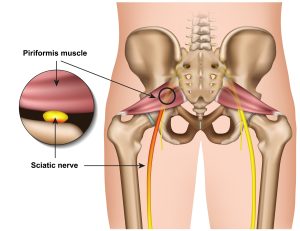
The “glute amnesia” cascade is the primary culprit. In a flexed cycling position, your gluteus maximus is often neurologically inhibited (turned off). To stabilize your hip, the smaller piriformis muscle works overtime. Over time, it hypertrophies or spasms, compressing the sciatic nerve.
This explains the “sciatic tingle” many cyclists experience—brief flashes of numbness or heat in the glute or hamstring during or after rides.
Modifiable Risk Factors
Saddle Height: Too high causes your hips to rock side-to-side, creating shearing forces on the discs. Too low forces excessive posterior pelvic tilt (rounding), overloading the lumbar spine.
Reach and Drop: Excessive reach forces you to over-flex the spine to reach the handlebars. Many cyclists training in Centennial ride bikes that are too aggressive for their current mobility, forcing compensations that stress the lower back.
Biomechanical Factors
Hip Flexor Tightness: Tight psoas muscles pull the lumbar spine forward, fighting against your glutes with every pedal stroke. Hours in the saddle shorten these muscles progressively.
Hip-Spine Dissociation Failure: Your hip joint should move through a massive range of motion (flexion to extension) while your lumbar spine remains relatively still. If your hips are tight, your back moves to compensate, creating repetitive stress.
The Bulletproofing Protocol for Centennial Cyclists
This protocol addresses mobility restrictions, builds stability through Dynamic Neuromuscular Stabilization (DNS) principles, and creates the muscular armor needed for high-volume riding.
Phase 1: Mobility Work (The “Un-Gluing” Phase)
Couch Stretch (2 minutes per side)
- Targets the rectus femoris and psoas to allow hip extension without arching your back
- Do this post-ride when tissues are warm
- Critical for cyclists who ride in aggressive positions
Thoracic Cat-Cow (15 reps)
- Mobilizes your upper back so your lower back doesn’t compensate for stiffness up the chain
- Many cyclists develop thoracic stiffness from prolonged flexed positions
- Restores the spine’s ability to distribute stress across multiple segments
Active Pigeon Pose (2 minutes per side)
- Stretches the piriformis and external hip rotators
- Active version: engage the glute of the stretched side to enhance the release
- Particularly important for mountain bikers and gravel riders dealing with technical terrain
Phase 2: Stability Work (DNS Principles)
At Kinetic Sports Medicine and Rehab, our sports chiropractors use DNS principles to rebuild the foundational stability that cycling erodes.
DNS 3-Month Supine (2 minutes)
- Lie on your back, legs up, focus on expanding your lower abdomen with breath
- Trains intra-abdominal pressure (IAP)—your body’s natural weight belt
- Critical for cyclists who chest-breathe during efforts, losing core stability
Bird-Dog (2 sets of 10, slow and controlled)
- The gold standard for back health in cyclists
- Teaches your body to extend the hip (like a pedal downstroke) while keeping the spine neutral
- Focus on zero movement in the lumbar spine during the leg extension
Dead Bug with Wall Push (2 sets of 10)
- Push your hands into a wall behind you while lowering alternate legs
- High activation of the anterior core without spinal flexion
- Builds the anti-extension strength cyclists need
Phase 3: Strength Work (The Armor)
Single-Leg Romanian Deadlift (3 sets of 8)
- Builds hamstring and glute resilience plus single-leg balance
- Addresses the asymmetries many cyclists develop from favoring one leg
Pallof Press (3 sets of 12)
- Anti-rotation strength to resist the torque of pedaling
- Use a resistance band anchored at mid-torso height
- Critical for preventing the spine rotation that causes disc stress
Weighted Step-Ups (3 sets of 10)
- Mimics pedal stroke mechanics under heavy load
- Builds the glute strength that protects your back during climbs
- Use a height that brings your thigh parallel to the ground
How Sports Chiropractors Support Cyclist Performance in Centennial
At Kinetic Sports Medicine and Rehab, our sports chiropractic approach views cyclists through a “whole kinetic chain” lens, not just isolated body parts.
Dynamic Neuromuscular Stabilization for Cyclists
We view your core as a cylinder. The diaphragm is the lid, the pelvic floor is the base. In cycling, if you breathe shallowly into your chest (stress breathing during hard efforts), you lose the “lid” of your stability.
Our sports chiropractors teach cyclists to breathe into their lower back to create a natural weight belt. This IAP is what protects your spine during hours in the saddle.
Addressing Fear-Avoidance in Aggressive Positions
We use a biopsychosocial model to address the “fear of the drop bars.” If you fear pain in the aero position, you’ll subconsciously guard (tense up), which increases muscular fatigue and creates the pain you’re trying to avoid.
Our sports chiropractors build confidence through graded exposure to aggressive positions combined with the prehab work that makes those positions sustainable.
Treatment That Complements Your Prehab Work
Regular maintenance with sports chiropractic care and sports massage creates the optimal tissue environment for your prehab work to be effective.
Sports Chiropractic Joint Mobilizations
Sports chiropractors restore movement to stiff lumbar vertebrae and SI joints that get “jammed” from long rides. When these joints are restricted, surrounding muscles work overtime to compensate, leading to the fatigue and pain cyclists experience.
Chiropractic adjustments for cyclists focus on maintaining the spine’s ability to distribute forces evenly across all segments, preventing any single area from becoming overloaded.
Sports Massage for Cyclists
Sports massage is highly effective for the chronic muscle tension cyclists develop. Deep tissue work on the psoas, quadratus lumborum, and paraspinal muscles addresses the shortened, overactive tissues that pull your spine out of optimal alignment.
Sports massage also “unsticks” the psoas muscle from the abdominal wall using techniques like Active Release Technique (ART), allowing your hips to extend fully during the pedal stroke. Many cyclists report immediate improvement in their position on the bike after sports massage addressing hip flexor restrictions.
Dry Needling for Piriformis Syndrome
Dry needling is particularly effective for piriformis syndrome in cyclists. It releases deep trigger points in the glute and piriformis that manual therapy can’t reach, relieving pressure on the sciatic nerve.
Many Centennial cyclists dealing with numbness or tingling during rides experience significant relief after 2-3 dry needling sessions combined with the prehab protocol.
Smart Training Integration for Busy Cyclists
Don’t add this protocol on top of your current training—integrate it strategically.
Pre-Ride (5 Minutes): Activation Only
- Bird-dogs and glute bridges
- Wake up the stabilizing muscles before you ride
- Particularly important before long weekend rides
Post-Ride (10 Minutes): Mobility
- Couch stretch and pigeon pose
- Restore length to tissues that were shortened for hours
- Do this when muscles are warm and pliable
Strength Days (2x Per Week)
- Perform heavy strength work (RDLs, step-ups, Pallof press) on days with shorter, lower-intensity rides or rest days
- Don’t do heavy strength work the day before your long ride or key workout
Warning Signs: When to Back Off and Focus on Prehab
Pay attention to these signals that your back is approaching a threshold:
Morning Stiffness: Your back takes more than 30 minutes to “warm up” the day after a ride
Saddle Shifting: You constantly have to scoot back or shift position to get comfortable during rides
The Sciatic Tingle: Brief flashes of numbness or heat in the glute or hamstring—this is your piriformis signaling it’s nearing failure
Position Changes: You find yourself riding on the hoods more and avoiding the drops because your back hurts in aggressive positions
If you’re experiencing any of these, it’s time to reduce training volume temporarily while you implement this prehab protocol. Pushing through these warning signs is how mild discomfort becomes chronic injury.
The Research Supporting This Approach
A 2015 study in the Journal of Strength and Conditioning Research found that cyclists who underwent a core fatigue protocol saw significant alterations in pedaling mechanics, leading to increased knee and ankle strain. This demonstrates the critical role of core endurance in maintaining efficient, injury-free cycling mechanics.
Research by Solomonow et al. on flexion intolerance shows that sustained flexion (the aero position) causes creep in posterior spinal ligaments, reducing their stabilizing capacity for up to 24 hours post-ride. This explains why proper prehab focused on building endurance in spinal stabilizers is essential for cyclists.
Frequently Asked Questions from Centennial Cyclists
How long does it take to see improvement in back pain? Most cyclists notice reduced post-ride stiffness within 2-3 weeks of consistent prehab work (4-5 days per week). Complete resolution of symptoms typically takes 6-8 weeks, though you can continue increasing training volume during this period.
Can I still ride while doing this protocol? Absolutely. This protocol is designed to be done alongside your training, not instead of it. The key is smart integration: mobility post-ride, activation pre-ride, strength work on easier training days.
Do I need a new bike fit? Not necessarily. Many cyclists blame bike fit when the real issue is mobility and stability deficits. Implement this protocol for 4-6 weeks. If symptoms persist despite proper prehab work, then consider a professional bike fit from a fitter experienced with sports chiropractic principles.
Will this help with piriformis syndrome? Yes. The combination of glute strengthening, hip flexor mobility, and core stability work directly addresses the mechanical causes of piriformis overload. Combined with sports massage or dry needling from a sports chiropractor, most cyclists see significant improvement.
Your Back Shouldn’t Be Your Limiting Factor
Your cardiovascular system and leg strength should determine how far and fast you can ride—not your lower back. At Kinetic Sports Medicine and Rehab in Centennial, our sports chiropractors work with cyclists who refuse to accept back pain as “just part of cycling.”
The difference between cyclists who can sustainably train 200+ miles per week and those who are constantly managing back issues isn’t genetics or age—it’s systematic preparation of the tissues and movement patterns that cycling demands.
This prehab protocol is your investment in longevity. It’s the difference between riding strong for another decade versus gradually reducing volume because “your back can’t handle it anymore.”
Schedule Your Cyclist-Specific Assessment in Centennial
Whether you’re preventing future back issues or addressing early warning signs, a comprehensive cycling-specific movement assessment identifies your unique weak points.
At Kinetic Sports Medicine and Rehab, our sports chiropractors evaluate hip mobility, spinal stability, breathing mechanics, and pedaling-specific movement patterns to create personalized prehab strategies.
Your assessment includes:
- Thomas test, straight leg raise, and Trendelenburg screening
- Spinal mobility and segmental motion evaluation
- Hip flexor length and glute activation testing
- Breathing pattern assessment for IAP optimization
- Sports chiropractic treatment including joint mobilization and sports massage to address current restrictions
- Personalized exercise prescription based on your riding volume and goals
Stop letting your back dictate your training volume. Get the assessment that shows you exactly what your spine needs to handle the miles you want to ride.
Kinetic Sports Medicine and Rehab
Centennial, Colorado 80112
Phone: 720-709-1894 (call or text)