
Published: January 2026 | Reading Time: 9 minutes
If you’re a bodybuilder or dedicated lifter training at 24 Hour Fitness on Arapahoe Road, Vasa Fitness in Greenwood Village, or pushing heavy weight in your home gym near The Streets at SouthGlenn, you know the frustration of shoulder pain that won’t quit. You try to “train around it” with ibuprofen and a week off, but the moment you load an incline press, that sharp ache returns.
At Kinetic Sports Medicine & Rehab in Centennial, we specialize in getting South Denver lifters back under the bar stronger than before. Nagging shoulder pain isn’t a sign your career is over—it’s a sign your stabilization strategy needs a scientific “software update.”
Understanding Shoulder Pain in Weightlifters: Why Rest and Ice Fail
In a sport centered on mechanical tension, the actual weight on the bar is rarely the primary culprit. Research shows shoulder injuries account for 22% to 36% of weightlifting setbacks, but these are rarely acute accidents. Instead, they are failures of joint centration.
The “Golf Ball on a Tee” Mechanism
Think of your shoulder like a golf ball on a tee. To move heavy weight safely, the ball must stay perfectly centered. In bodybuilding, we often over-isolate the “mirror muscles” (pecs and delts), neglecting the reflexive stabilizers that keep the “ball” centered during a grind.
When your nervous system fatigues during a high-volume block, your shoulder blade stops rotating upward correctly. It tips forward, the “tee” tilts, and your rotator cuff gets crushed under the load. This is why you can bench 315 lbs one week and struggle with 225 lbs the next—your stabilization system, not your muscle, broke down.
The 3 Most Common Bodybuilding Shoulder Injuries in Centennial
Most lifters visiting our Centennial sports chiropractic clinic fall into these three categories:
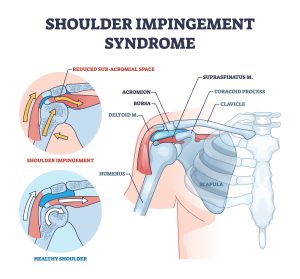
- Subacromial Impingement (The “Pinch”): The supraspinatus tendon gets squeezed under the acromion (the bony point of your shoulder). This is common for those training at Club Greenwood or Highlands Ranch gyms who perform heavy lateral raises with poor scapular control.
- Biceps Tendon Overload: The long head of the biceps often takes the “overflow” of tension during deep dips or heavy flies. This presents as a dull, nagging ache in the front of the shoulder.
- Weightlifter’s Shoulder (AC Joint Stress): A stress reaction where the collarbone meets the shoulder blade. Usually caused by “bottoming out” on heavy bench presses or dips.
Evidence-Based Treatment at Kinetic Sports Medicine
A 2018 landmark study in the Bone & Joint Journal proved that surgery for shoulder impingement offers no better results than a properly structured exercise program [1]. We leverage three specific strategies for our Centennial athletes:
1. Heavy Slow Resistance (HSR) Protocol
We skip the 2lb pink dumbbells. Tendons require mechanical loading to heal. We use a 3-second concentric and 3-second eccentric tempo. This “Time Under Tension” signals your body to rebuild collagen, making the tendon thicker and more resilient [3].
2. Dynamic Neuromuscular Stabilization (DNS)
We fix the “software” of your movement. Using DNS principles—like the Modified Bear—we retrain your brain to anchor the shoulder blade against the ribcage. This ensures the “tee” stays level even when you’re pushing for a PR.
3. Dry Needling and Manual Therapy
We use Dry Needling in our Centennial office to shut down pain signals. This creates a “therapeutic window” where you can actually perform the heavy loading necessary for long-term repair. It’s not just about relief; it’s about restoring the ability to train.
Activity Modification: Don’t Stop Training
The biggest mistake Centennial bodybuilders make is stopping altogether. This causes atrophy. Instead, we use a tiered return-to-play protocol:
- Phase 1: Use Neutral Grip variations (Swiss bars or dumbbells) and Isometrics to maintain muscle mass without aggravating the joint.
- Phase 2: Progressive HSR work focusing on the eccentric (lowering) phase.
- Phase 3: Return to competition-level volume using sport-specific loading tolerance tests.
Why Choose Kinetic Sports Medicine in Centennial?
We aren’t a traditional insurance-based clinic that gives you three exercises and leaves you with a tech.
- We Understand the Iron: We know the difference between a Powerlifting “grinder” and Bodybuilding volume.
- Performance First: We don’t just want you pain-free; we want you hitting PRs.
- Local Expertise: Located conveniently for athletes in Centennial, Greenwood Village, and Littleton.
Stop training around the pain. Schedule your one-on-one assessment today and get back to 100%.
Book an Appointment: Book Now With Centennial, CO’s Shoulder Experts
Frequently Asked Questions (FAQ)
How long is the recovery for a weightlifting shoulder injury? Most Centennial lifters see significant improvement in 4–6 sessions. Full return to competition loads typically takes 8–12 weeks.
Do I need an MRI first? Rarely. Research suggests most impingement cases respond to conservative care. We only order imaging if there is a suspected full-thickness tear or no progress after 6 weeks.
Is your clinic near me? We are located in Centennial, CO 80112, easily accessible from I-25 and Arapahoe Road, serving South Denver, Highlands Ranch, Parker, Castle Rock, and Lone Tree.